


Free Shipping All Orders Over $95
California residents received more than 50,000 U.S. patents in fiscal year 2025, more than the next six states combined and over four times Texas's total, according to the Governor's Office.
That number is the cleanest way into a question people usually answer with weather and traffic. Patents measure output rather than reputation, and output is where the state's differences show up. California isn't unusual because of sunshine or because one industry got lucky. It's unusual because scale, terrain, research capacity and a distinct legal code sit in the same place and keep pushing each other forward.
What follows takes those in order: the land and its climates, the people and the food they cook, the industries and the money behind them, and finally the law, where the state's newest break with federal rules is changing what a customer can legally buy.
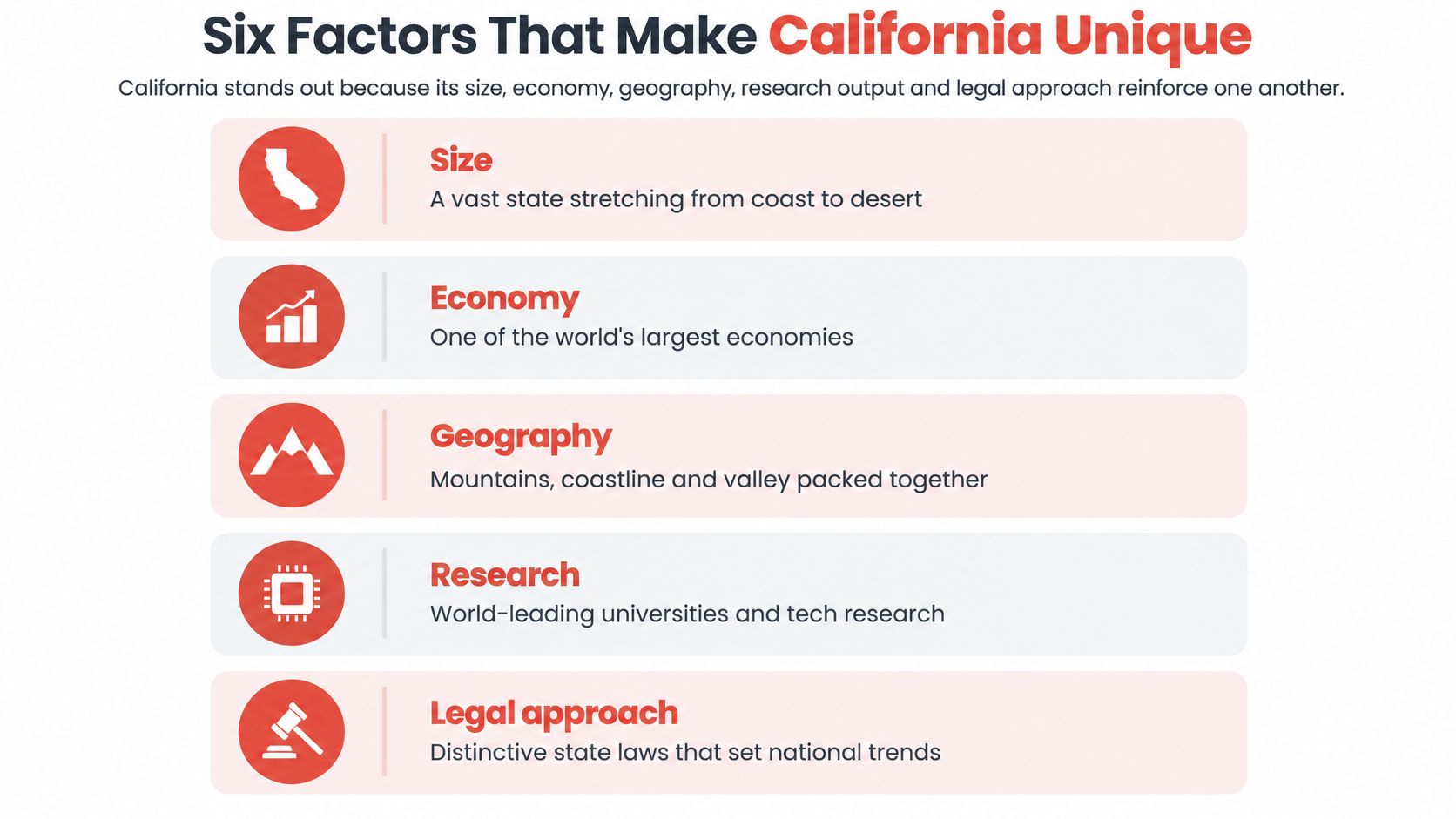
California stands out because its size, economy, geography, research output and legal approach reinforce one another, and no other state assembles all five in the same package. Any single one of them exists elsewhere. The combination doesn't.
The numbers below carry the scale, so the rest of this guide can spend its words on how the pieces work rather than what they are.
| Factor | Key figure | Why it matters |
|---|---|---|
| Population scale | 39,355,309 residents (July 1, 2025) | Largest U.S. state and a large test market of its own |
| Economic output | About $4.3 trillion GDP in 2025 | Roughly 14% of the U.S. economy |
| Biodiversity | More than 6,500 native plant types, over 2,000 endemic | Climate and species vary sharply by region |
| Innovation | More than 50,000 patents in fiscal 2025 | More patents than the next six states combined |
| Corporate presence | 57 Fortune 500 companies (2024) | The most of any U.S. state |
| Hemp rules | Total THC includes THCA, effective January 1, 2026 | Stricter than the federal 0.3% Delta-9 rule |
The population figure is the Census Bureau's estimate for July 1, 2025, published in QuickFacts for California, which also records a 2020 land area of roughly 155,858 square miles, or 253.7 people per square mile. The corporate count comes from the Governor's Office, which tallied 57 Fortune 500 companies headquartered in the state in 2024, more than any other state.
Read the rows together and the mechanism appears. A consumer market that large lets a company test a product on millions of people before deciding whether to ship it nationally, and a research base that deep keeps refilling the pipeline of things worth testing. Strict rules then decide which of those products survive to the shelf.
Each factor gets its own treatment below, starting with the ground itself.
California is less one climate than a stack of several, packed into a state you can drive across in a long day. That stacking is why any single sentence about "California weather" is wrong somewhere in the state at any given hour.
The machine behind it is the mountain ranges. Wet air arrives off the Pacific, hits the coast ranges, then the Sierra Nevada, and gets forced upward. Rain falls on the western slopes, and the air that descends on the far side is dry, which is how Death Valley sits in the same state as redwood forest.
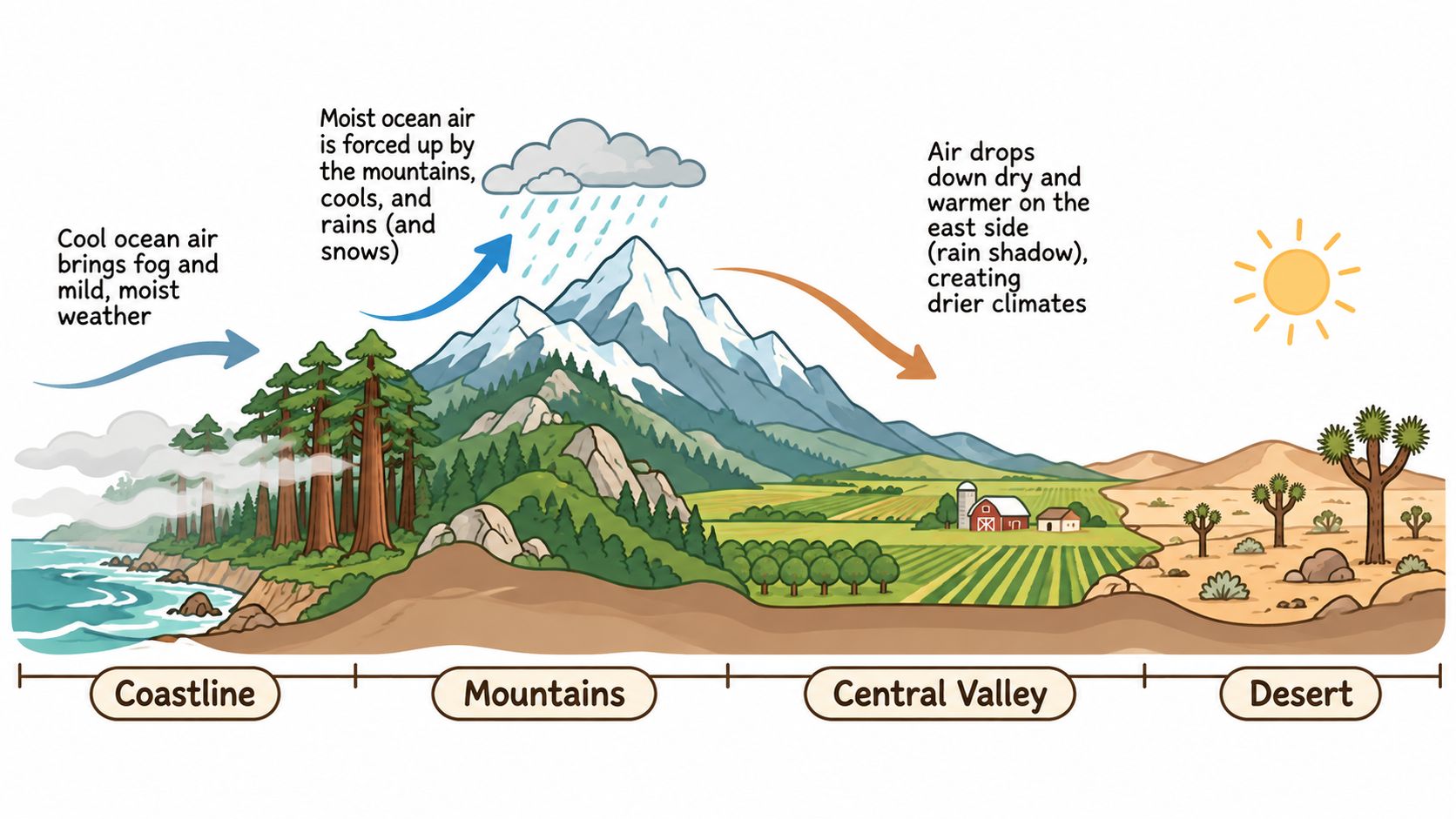
Between the coast ranges and the Sierra runs the Central Valley, a trough of irrigated farmland that produces a large share of the country's tree fruit, nuts and vegetables. The regions below are the shorthand version.
| Region | Climate pattern | Known for |
|---|---|---|
| Northern Coast | Cool, foggy summers and wet winters | Redwood forests and wine grapes in Sonoma and Mendocino |
| Central Valley | Hot, dry summers with irrigated farmland | Almonds, tomatoes, grapes and dairy |
| Sierra Nevada | Heavy winter snowpack that melts into summer runoff | Water storage for reservoirs and rivers |
| Southern Coast | Mild, dry winters and warm summers | Citrus and avocados in San Diego and Ventura counties |
| Desert (Mojave and Colorado) | Extreme summer heat and very little rain | Solar farms and winter tourism |
The variation isn't only scenic. The California Department of Fish and Wildlife maps biodiversity, rarity, endemism, habitat connectivity and climate vulnerability across a terrestrial grid of hexagons roughly 2.5 square miles each, as described in the state's Areas of Conservation Emphasis dataset. That resolution exists because species distributions shift sharply across elevation, soil type, coastal exposure and rainfall, and more than 2,000 of the state's native plants grow nowhere else, about a third of its native flora.
A single statewide "California profile" misleads growers, buyers and planners. A crop suited to a foggy coastal bench fails in the Central Valley; a water strategy built for one watershed doesn't transfer to the next.
A short walk through the same geography is easier to remember than a paragraph about it.
Practical rule: Treat "California grown" as a starting point, not an answer. The region, the season and the water source behind a product tell you far more than the state line does, which is why growers who work outdoors talk about sun-grown cannabis in terms of specific microclimates rather than a state average.
When a label or a seller names a county or a valley instead of just a state, that's a signal they know where their product comes from.
Start in Los Angeles on a weekday morning. Within a few blocks you can buy conchas from a Mexican bakery, banh mi from a Vietnamese counter, pupusas from a Salvadoran grill and lahmajoun from an Armenian deli, and the people in line at each one are not all from the same neighborhood.
Drive north for a few hours and the picture changes without loosening. In a Central Valley farm town, the family that owns the orchard and the crew that picks it eat at the same diner, and the menu carries both the tacos and the pot pie.
That density of cooking traditions isn't a marketing claim, it's an everyday pattern in a state where no single group is the majority. Neighborhood restaurants carry dishes that arrived with migration and stayed, adjusted to local produce and local customers. Filipino, Chinese, Korean, Central American and Armenian kitchens show up in strip malls as often as in food halls, which is a true measure of a food culture.
Farm-to-table isn't a separate scene competing with those kitchens. Both buy from the same regional supply. A restaurant can build a menu around produce grown within a short drive of the kitchen and still sell a plate that costs less than a movie ticket.
The stacked climates from the previous section are visible in what a single day can contain. A morning on a cool, foggy coast, an afternoon of snow in the Sierra and an evening of warm desert air all fit inside one state, and the food changes with each: oysters and artichokes near the water, stone fruit through the valley, dates and citrus in the south.
Cooking here is regional in a way that's easy to miss from outside. Ask what's local and you get five different answers depending on which hundred miles you're standing in.
For a reader who wants to understand the state rather than just visit it, the cheapest education is food. Order the regional dish instead of the familiar one, and shop at a farmers' market in a part of the state you haven't spent time in. You'll learn more about the place from a stallholder than from any scenic overlook.
The openness the state is known for is mostly this, repeated at scale: many traditions, one shared set of streets and markets, negotiated daily over lunch.
California's economy grew 90% over the preceding 25 years, against 69% growth nationally, and the state added nearly 3 million jobs since 2005, according to California government reporting based on Bureau of Economic Analysis data. The same reporting puts gross domestic product at approximately $4.3 trillion in 2025, about 14% of the entire U.S. economy.
Size changes what a state can do. A market this large lets a company launch a product, watch how millions of people respond and adjust before committing to a national rollout. It also lets regulators test rules on a population bigger than most countries, which is why standards set here tend to travel.
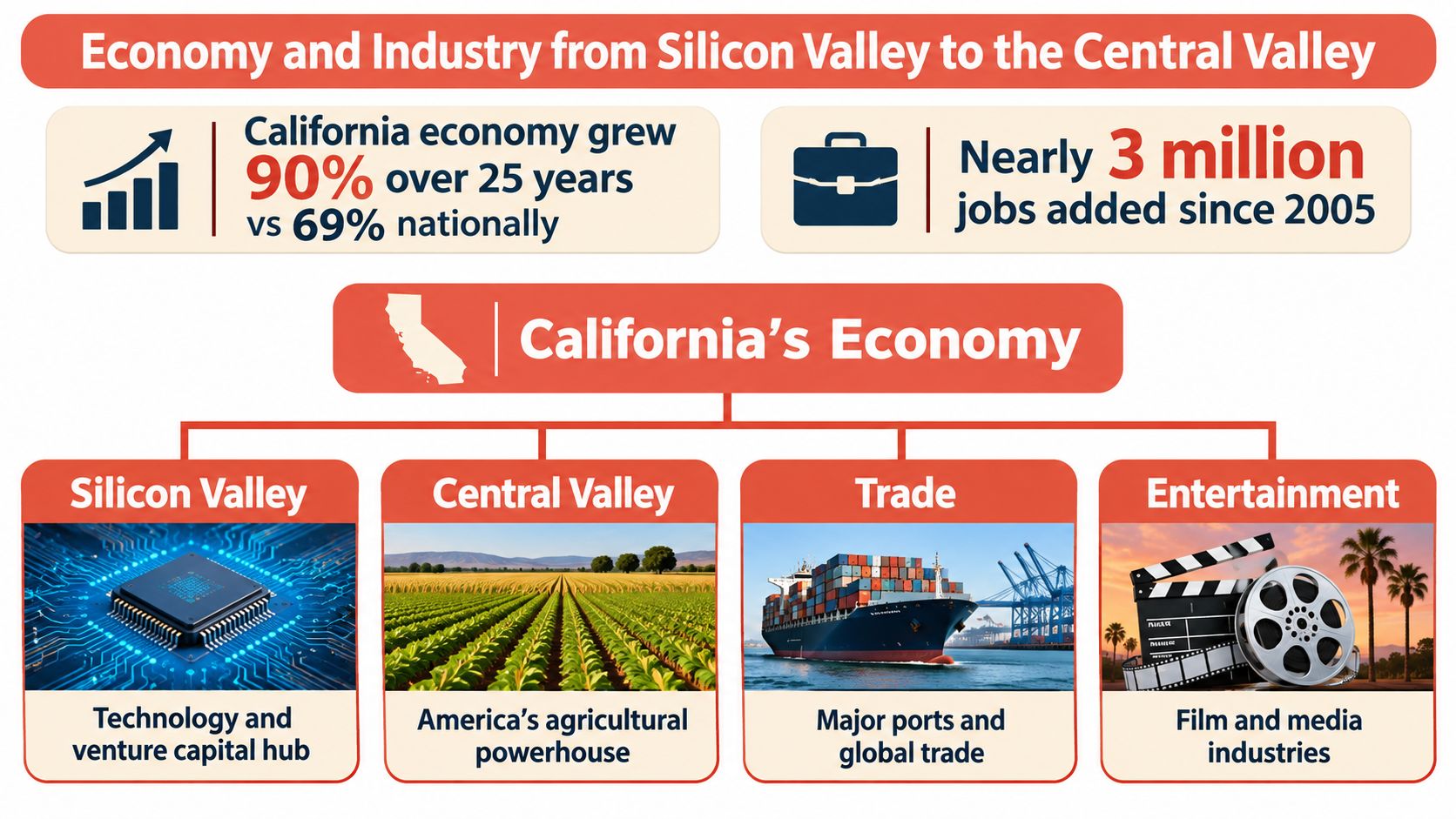
The output isn't spread evenly. Each industry clusters where its suppliers, workers and capital already are.
| Industry | Main hub | Typical output |
|---|---|---|
| Technology | Bay Area (Silicon Valley) | Software, hardware and internet platforms |
| Entertainment | Los Angeles | Film, television, music and animation |
| Agriculture | Central Valley | Almonds, tomatoes, grapes and dairy |
| Life sciences | San Diego | Biotechnology and medical devices |
| Tourism | Sierra and coastal parks | Yosemite, Big Sur and Lake Tahoe visits |
| Ports and logistics | Los Angeles and Long Beach | Cargo gateways for Asia trade |
A film crew, a software studio and a hardware maker don't compete for the same customers, but they draw on the same vendors, the same contract lawyers and much of the same investment money. When one cluster invents a way of working (a production pipeline, a testing protocol, a distribution model), the others borrow it.
Below that layer sits a very long tail. More than 4.3 million small businesses operate in California, representing 99.8% of all businesses and employing 7.6 million people, per the same state economic report. Most of them are nobody's idea of a California company: machine shops, trucking firms, labs, farms, design studios.
University and company research labs sit in the same corridors as the industries that hire their graduates, which keeps specialized talent within commuting distance of the work. That proximity is why products from here often compete on formulation, testing and design rather than on price alone. A brand built in this environment has to survive buyers who read spec sheets and regulators who read them more closely.
The trade-off: Density makes experimentation cheap and failure visible. A company can move from prototype to shelf quickly, and a competitor two exits away can copy it just as quickly.
Here's the assumption worth testing. A hemp product that meets the federal 0.3% Delta-9 THC limit is legal in much of the country, so it must be legal in California. It isn't, and the gap between those two standards is now one of the state's defining features.
California law defines total THC as Delta-9 THC plus THCA, not Delta-9 alone, according to California Health and Safety Code section 11018.5. The same framework prohibits the in-state sale or delivery of hemp flower and hemp prerolls as of January 1, 2026.
That's a bigger shift than it sounds. THCA is the acidic form of THC, and it converts to THC when heated, which is what happens in a vape or a joint. A product can pass a federal test that measures Delta-9 alone and still deliver a meaningful dose, because the test never counted the THCA sitting next to it.
| Rule | Federal standard | California standard |
|---|---|---|
| Intoxicating threshold | 0.3% Delta-9 THC | Total THC counts Delta-9 THC plus THCA |
| Hemp flower and prerolls | Allowed if under the federal threshold | In-state sale or delivery prohibited from January 1, 2026 |
| Lab testing focus | Delta-9 THC content | Licensed labs must analyze THCA and other cannabinoids |
| Product legal in the other market | Federally compliant | May still be unlawful in California |
California's licensed-market testing rules require laboratories to analyze THCA and other cannabinoids, which means compliance turns on the complete cannabinoid profile rather than one number. A certificate of analysis that reports only Delta-9 is incomplete for a product sold here. So is a lab report that lists potency without the batch it came from.
For a retailer, this changes inventory. A shipment that's legal in another state can't cross the border into a California store. For a customer, it changes what "legal" means: the product type, the total THC figure and the state of purchase all have to line up at once.
Labels and testing requirements differ by state and change often, so the working rule is to check the current state cannabis laws for the state you're buying in rather than relying on a national standard.
California didn't loosen its approach. In 2025 the state adopted measures restricting intoxicating hemp products, including inhalable products, hemp flower, vape cartridges and products made outside the regulated market, as summarized by the California Cannabis Portal. Enforcement data reported in the same summary showed 99.7% compliance among relevant business licensees with the prohibitions on intoxicating hemp food, beverages and dietary products that year.
Put those two facts together and the state's cannabis identity looks nothing like the postcard version. California runs a highly regulated licensed cannabis economy and simultaneously tightens the border around hemp-derived intoxicants, age access, sourcing and retail channels.
The result: Legitimacy became part of the product. A batch-linked certificate of analysis, a label stating cannabinoid content and a clear distinction between state-legal cannabis and hemp now do the work that branding used to do.
That shift is the newest answer to what makes California unique. Other states argue about hemp in the abstract; California has a large enough legal market that its stricter reading functions as a de facto standard, and a counterexample to the idea that U.S. hemp rules are uniform. Where the market once competed on "California vibes," it now competes on traceability, terpene profiles and controlled sourcing.
For shoppers 21 and older, the practical consequence is simple. You judge a product by its documentation at least as much as by its flavor, and you read the total THC figure before you read the marketing.
Use this checklist before you pay, whether you're buying in a store or ordering online. Each step exists because of a specific failure that's easy to walk into.
The common slip is buying on federal compliance alone. Federal compliance is the floor, not the local rule.
Growers who control their own supply tend to have the batch records ready, because the flower never passes through three intermediaries before it reaches a customer. Melt grows its flower on its own farm in Los Angeles and ships it straight to customers, which keeps the batch behind each package traceable to a single source.
Judge every seller, including Melt, on whether the batch-level lab reports are published for the specific product you're ordering. If they aren't, that's your answer.
California's hemp rules are stricter than the federal standard in ways that matter at checkout, so the products Melt grows on its own Los Angeles farm come with batch-level lab reports you can match to the package in your hand. Browse the Melt collection of THCA flower, prerolls and edibles, then open the certificate of analysis for the batch you're considering before you order. Start with one product, compare its total cannabinoid figures against the report, and let the documentation make the decision for you.
Your cart is currently empty.